


And So Ends The World - Withering In A Cosmic Holocaust
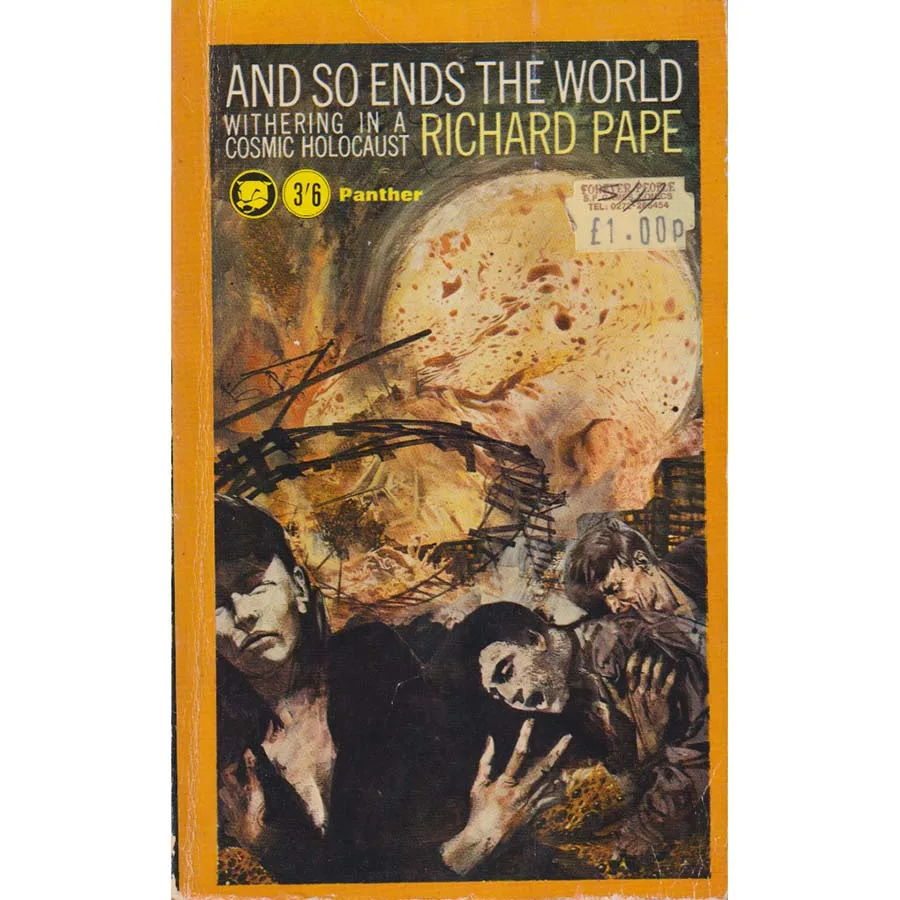
Publisher: Panther
Format: Paperback
ISBN: none
And So Ends the World: Withering in a Cosmic Holocaust (1963) – Richard Pape
Panther | ISBN: None
Condition: Good | Sold by Crappy Old Books
The end of the world. A subject which has fascinated humanity for thousands of years, inspiring prophets, philosophers, scientists and an impressive collection of individuals convinced that civilisation will collapse immediately after their particular generation has finished complaining about it.
But what if the apocalypse were not merely a distant possibility? What if the familiar world, with all its comforting routines, political absurdities and reassuring little conveniences, were approaching a rather more permanent conclusion?
Welcome to And So Ends the World: Withering in a Cosmic Holocaust, Richard Pape’s dramatically titled excursion into the terrifying possibilities of planetary catastrophe, published at a time when the prospect of civilisation being abruptly extinguished was considerably more fashionable than anyone might have wished.
The early 1960s were an exceptionally nervous period. Nuclear arsenals were expanding, the Cold War was approaching extraordinary levels of confrontation, and humanity had acquired the remarkable technological ability to accomplish in an afternoon what nature might otherwise require millions of years to achieve.
Meanwhile, scientific discoveries were revealing a universe of almost unimaginable scale, filled with powerful forces that made human civilisation appear rather less permanent than its inhabitants preferred to believe.
Against this unsettling background, a title promising a cosmic holocaust was hardly calculated to improve anybody’s peace of mind.
Richard Pape himself was no stranger to catastrophe. A wartime airman, prisoner of war and author of the celebrated memoir Boldness Be My Friend, he had experienced danger, captivity and survival under conditions that would leave most ordinary individuals permanently reluctant to complain about a delayed train.
There is something particularly arresting about an author with such experiences turning his attention towards destruction on a cosmic scale.
The book belongs to that wonderfully dramatic tradition of mid-twentieth-century writing in which humanity’s future is examined with an enthusiasm for alarming possibilities and an admirable disregard for reassuring the reader.
Its appeal today extends beyond the subject itself. As a 1963 publication, it offers a period perspective on an age when atomic anxiety, scientific progress and apocalyptic speculation occupied a prominent place in the popular imagination.
There is also something deliciously ironic about civilisation devoting its extraordinary intellectual resources to understanding the universe, only to discover an ever-expanding catalogue of ways in which the universe might bring civilisation to an end.
This 1963 Panther edition, offered in Good condition by Crappy Old Books, is an appealing acquisition for collectors of vintage paperbacks, enthusiasts of apocalyptic literature and readers fascinated by the anxieties and dramatic imagination of the Cold War era.
A gloriously ominous addition to any bookshelf, with a title that makes even the most pessimistic modern newspaper headline sound positively cheerful.
Because everybody knows the world must end eventually.
The Sun will not shine forever, the stars themselves have finite lives, and even the greatest achievements of human civilisation cannot escape the passage of cosmic time.
Still, there is something wonderfully British about publishing a paperback explaining the possible extinction of everything.
At least it gives you something interesting to read while waiting for the end.
Provided, of course, the universe has the courtesy to let you finish the last chapter.
Keep browsing: See more Fiction books Other books by Richard Pape
